

What Comes After Everything Changes?
The Singularity is upon us. Now what?

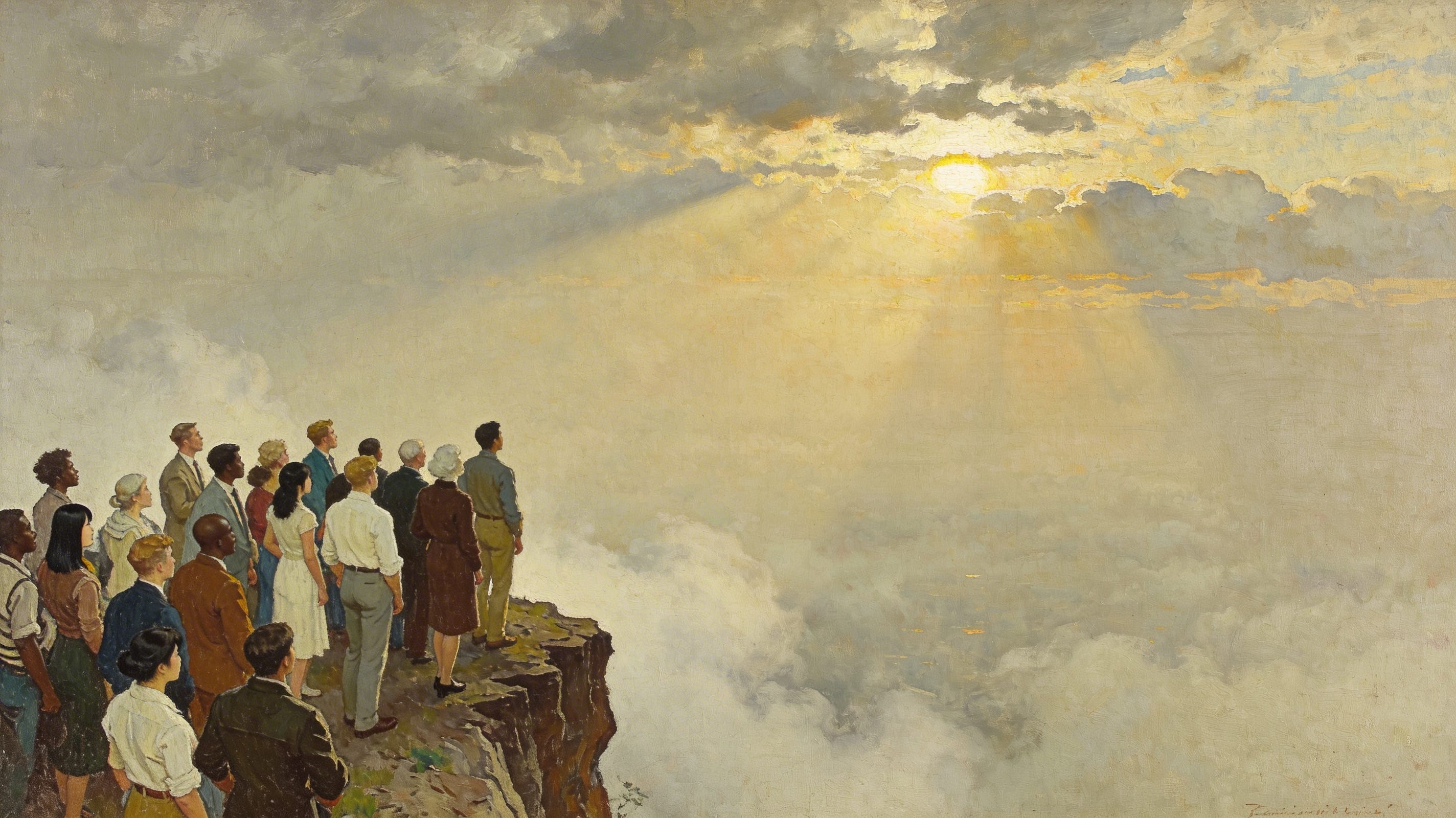
Here’s what I keep coming back to. Ray Kurzweil’s Singularity isn’t a horizon anymore - it’s the ground beneath our feet.
We spent decades treating it like a distant weather system. Twenty years out. Fifty. Something to theorize about over conference room coffee while the quarterly numbers scrolled past on the screen behind us. But the math has caught up with the metaphor, and the pace of change is no longer accelerating toward some future threshold. It has crossed it (or will soon). Whether the window is one year or two or five is a rounding error at this point. It’s here. It’s now. The clocks are already running.
The singularity, at its core, is about two things. First: the pace of change is increasing faster and in greater ways than it has at any prior moment in human history. Second - and this is the part that keeps me up at night - nobody really knows what’s waiting on the other side. Not at a business level. Not at a personal one. Certainly not at the societal and civilizational level where the consequences will ultimately be written. The singularity isn’t just a technological event. It’s an epistemological one. We don’t know what we don’t know about what comes next.
Which means that those of us who are starting to perceive this have a responsibility. Not just to watch, not just to commentate, but to start actively envisioning what the far side looks like - and then trying to build toward it. The singularity will bring destruction. That’s not pessimism, it’s arithmetic. Institutions will fracture. Organizations will become unrecognizable or irrelevant. And let’s not dress it up: people will be displaced, disoriented, worse off for a while. Our job - if we choose to accept that framing - is to engineer the softest landing we can. To thread the needle between here and something better, something more sustainable, with as little wreckage as possible strewn along the path.
But the pace doesn’t slow down because we wish it would. That’s not on the table.
I heard a concept recently that lodged itself somewhere useful in my thinking. We’ve always measured IQ - the intellectual quotient, the old reliable metric of raw cognitive horsepower. Then a few decades back, EQ entered the vocabulary: emotional quotient, the capacity to read a room, to connect with humans at a human level. Both of those matter enormously. But I think the singularity demands a third metric, one we haven’t spent nearly enough time developing. I’ve heard it called AQ. The adaptability quotient.
IQ, EQ, AQ. Three different lenses on what it means to be human, related but not reducible to one another. Your AQ, as I think about it, is a measure of your willingness and ability to accept change - not to tolerate it with gritted teeth, but to move with it, to find your footing in shifting terrain, to update your map when the territory has already moved on without you. That’s a different skill than being smart. It’s a different skill than being emotionally attuned. And in the world we’re entering, it may be the one that matters most.
But here’s where it gets interesting. AQ can’t be only an individual attribute. Because human beings are not optimized to act alone. We never have been. From the first hunting party that figured out how to bring down a woolly mammoth through coordinated strategy and shared intent, to the modern corporation aligned around a business outcome, our deepest evolutionary advantage is collective action. We are built for groups - for coordination and alignment and independent contribution operating in parallel. The group is the unit of human capability.
Which means we need institutions with an adaptability quotient.
And those institutions, I’d argue, probably need to be built from scratch.
There are lessons from the pre-singularity world worth carrying forward. Mostly cautionary ones - tales of what happens when institutions become extractive, when hierarchy becomes its own purpose, when the org chart outlasts the problem it was designed to solve. More useful, maybe, to start with the negative space: if we know what doesn’t work, we can invert it. If an institution built as X failed in these specific and well-documented ways, what is not-X? What does the positive image of that look like? Go flaw by flaw. Flip each one. Build toward the inversion.
That exercise - systematic, unsentimental, creative - is perhaps where we have to start. Not evolve or incrementally change those institutions but to build new ones alongside the old with not-X in its bones and sinew. And chief among them should be adaptability - not as an abstract virtue, but as a design principle baked into the architecture of the institutions humans create and inhabit.
And we’d better get started. Because this is moving fast, and the gap between where we are and where we need to be is not closing on its own.
No one is coming to save us.
And we can’t afford to wait for someone to tell us what to do.
That is the very definition of ‘not-X’.
Because here’s the danger if we don’t. If those of us who think we understand what’s coming don’t provide a credible vision for the far side - something people can see and reach for and believe in - then their temptation will be to stop. To resist. To revert. The worst instincts of human behavior and thinking emerge when the world moves too fast for comfort. When things get scary, the impulse is to make it stop. And if it won’t stop on its own, the drive to try to stop it yourself (or with others) is all too tempting.
That path doesn’t get us anywhere worth going. All it produces is destruction without destination.
The other side exists. The question is whether we’re willing to do the work of imagining it clearly enough to build a way there.
I think Adaptability is extremely important, but there is another AQ being batted around: Artistic Intelligence. This includes adaptability,cognitive flexibility, curiosity, connection to the senses, awareness of emotion, creativity. It still needs a clear definition, but I think the new Q the universe is calling us to needs this level of complexity and openness.