

The Thing We Forgot
On what capitalism was supposed to do, and what happened to it

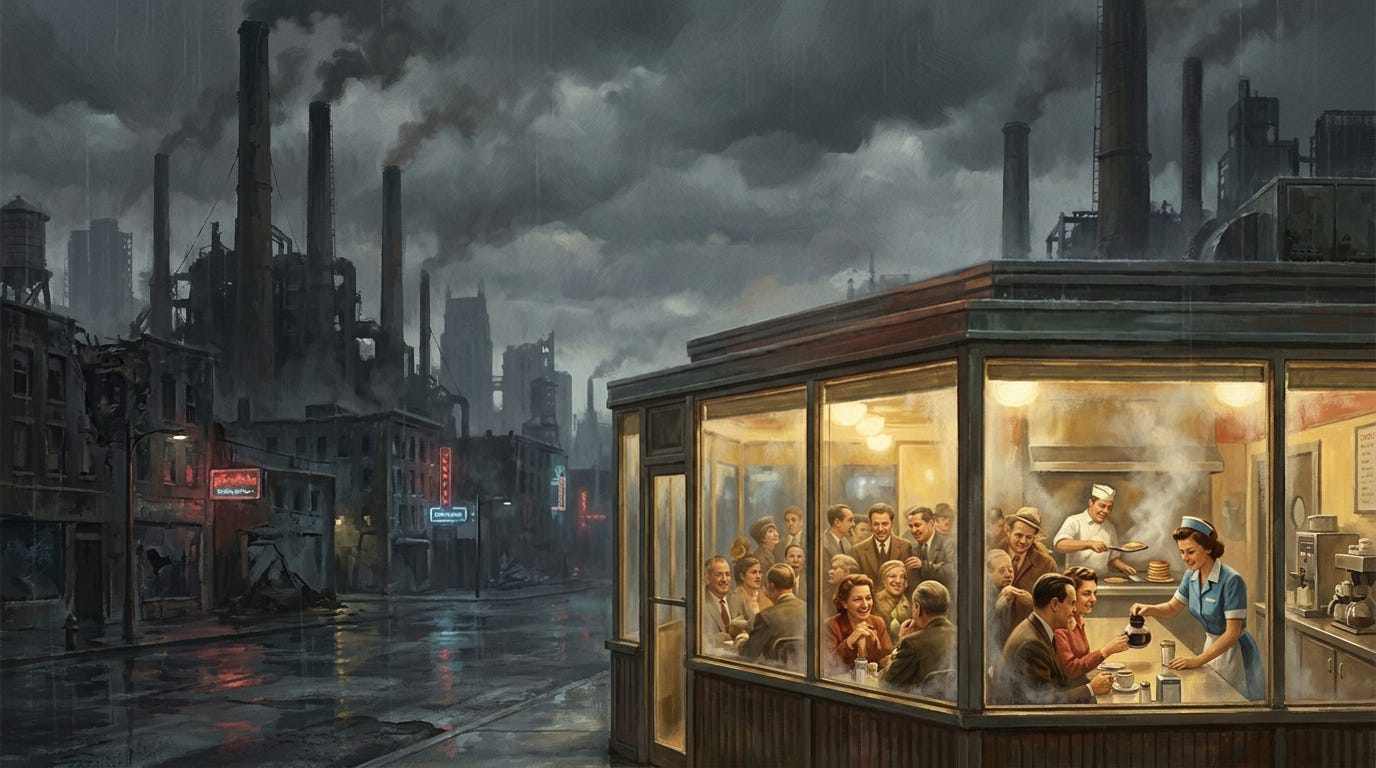
Here’s the deal with capitalism. Somewhere along the way, we forgot what it was actually for.
Not the recent interpretation of capitalism, either. Not the one where the M&A crowd assembled thelion’s share of the American economy into a handful of Game of Thrones houses dominated by a handful of ten-figure oligarchs defended by law and custom and societal malaise.
Before any of that. The forgetting happened slowly, the way a river changes course - imperceptibly, a little bit at a time, until one day you look up and the water is running somewhere completely different. You barely noticed the shift. But you can’t get back to where you started just by reversing your steps.
I’ve been thinking about this for a long time. And the more I think about it, the more convinced I become that the problem isn’t capitalism itself. The problem is what we turned it into.
The original idea
Capitalism’s original idea was almost embarrassingly simple: share the risk, share the reward, and create something worth more than what you put in - measured in human terms.
Land. Labor. Capital. Know-how. You bring those things together in the right way, and something happens. Something that shouldn’t be possible but is. The output is worth more than the sum of the parts. Not just in dollars. In solved problems. In fears quieted. In things people couldn’t do before that now they can. The magic of capitalism was that everybody won. The worker got a fair day’s pay for a fair day’s work. The customer got something worth every penny. The owner got a return on the risk they took. Round and round it went.
We had phrases for it back then. The customer is always right. Stand behind our product. A fair deal. These weren’t just slogans. They were the terms of a contract — implicit, unwritten, but real. You came to a business with a problem. The business solved it. You parted ways both better off than when you started. That was the transaction. And it was almost sacred in how cleanly it worked.
The extractive path
Now look around you.
Something has gone wrong - badly, visibly, undeniably wrong. And I think most people feel it even if they can’t quite put their finger on what it is. They feel it when they spend forty-five minutes on hold with the company that was supposed to serve them. They feel it when the product falls apart six months after the warranty expires, exactly as designed. They feel it when the employee handbook promises one thing and the actual job delivers something else entirely. They feel it in the slow creep of the sense that the system is not, actually, working for them. That they are, in some way they can’t quite name, being used.
They’re right. They are being used. Because at some point the whole model flipped.
The goal stopped being: generate value in excess of what you put in, and share the surplus with everyone who contributed to it. The goal became: extract as much wealth as possible from every person and resource you touch, and concentrate that wealth in as few hands as possible. The worker became a cost to be cut. The customer became a revenue stream to be maximized. The supplier became a margin to be squeezed. The community became an externality to be ignored.
Extractive capitalism doesn’t destroy value by accident. It destroys value on purpose, as a feature, not a bug - because everything that flows to employees or customers or communities is a dollar that doesn’t flow to the top.
I’m not saying this to be dramatic. I’m saying it because it’s structurally true. An extractive company isn’t badly run - it’s run exactly as intended. It’s just intended to do something that has nothing to do with the original promise at the heart of our 250-year-old system.
The Generative Path
The term I’ve settled on for the alternative - for people that are trying to do it the original way - is generative capitalism. And the place we have to start is with the Generative Startup.
Generative, because the whole point is generation. Creating something. Producing more value than you consumed. Not shuffling existing wealth from one pocket to another, not engineering financial outcomes while the actual product decays, but genuinely - stubbornly, unfashionably - making something that didn’t exist before and that people actually need.
Startup, because that’s where the leverage is. Large organizations are too far gone, too tangled up in the structures that serve extraction. A startup has the chance to build something different from the ground up - to make the choices that compound, to bake generosity and durability and honesty into the foundation before the concrete sets.
There’s nothing wrong with making money. Nothing wrong with generating a surplus. We’ve been doing that since we took up agriculture in the Euphrates Valley. Legendary capitalists understood this intuitively: a business that hollowed out its people or cheated its customers was a business eating its own seed corn.
The return for a generative company would come. But it would come because you’d created something real, something that people relied on and trusted and would pay for again and again. Durability was the asset. And the way you built durability was by actually giving a damn about the human beings involved.
That’s not naive. That’s the original model. The one that worked. And the one that generated more wealth faster than any period of human history.
Not lost, just ignored
Here’s what gets me. Millions of people are already doing this. Every day, in small businesses and family operations and bootstrapped startups all over the world, people are running companies the generative way - paying fair wages, standing behind their products, telling their customers the truth, building something meant to last. It’s not exotic. It’s not utopian. It’s what most people who start a business actually want to do, before the system applies its pressure and tells them they’re wrong to want it.
The extractive model is not inevitable. It’s a choice. A set of choices, actually, made repeatedly over time, each one small enough to seem reasonable in the moment and large enough to matter when you look back.
This book is about the other set of choices.
It’s about what it looks like, in practice, to build a company that generates more than it takes. That treats its workers like humans rather than inputs. That sees its customers as people to be served rather than metrics to be optimized. That understands intangible value - loyalty, satisfaction, trust, quality - as real wealth, not accounting sentiment.
The social contract at the heart of capitalism - the original one, before the extractive era began its dominion - was that our fundamental needs could be met, and that those willing to take the risks to meet them deserved to prosper for doing so. America, in particular, has never had a problem with wealth honestly earned by genuinely solving problems. That’s the deal. It’s a good deal. We just have to remember how to keep our end of it.
That’s what a generative startup does.
Let’s talk about how to build one.