


The Only Thing That Matters, Part 1 of 2.
In 2012 I started a company that worked.
That’s the part people don’t expect. The product worked. Customers used it. We raised a million dollars, built a real team, and ran the thing for four years. It was called Splitzee, and it was built on a premise that seemed almost too obvious to test: shared purchases are a pain: Splitting the cost of dinner. Chipping in for a group gift for Mom. Collecting money for the beach house, the bachelor party, the amateur hockey team’s ice time. Everybody has this problem, in a dozen different shapes, all the time. So we skipped the part where we found out whether anyone would pay us to solve it, and we built a group purchasing platform.
Four years. Five pivots. A million dollars. And at the end of it, a conclusion we could have reached in a few months for a few thousand dollars: the alternatives were too powerful to overcome. People already had ways of dealing with this problem. Those ways were messy and annoying, but they were good enough, and “good enough and already in my pocket” beats “slightly better and new” almost every time.
We didn’t fail because we built a bad product. We failed because we spent four years and our whole runway with a finished product in our hands, trying to find a market for it. We did it backwards.
I’ve been doing this for about thirty years. Six ventures as a founder, with one IPO, two sales and three shutdowns. Thirty-plus roles as an advisor, investor, executive and board member. More than 1,500 startups studied up close through the country’s most respected non-equity accelerator MassChallenge. And if I had to boil all of it down to one idea, it would be the one Marc Andreessen put in the title of a 2007 essay: product-market fit is the only thing that matters.
I say this to founders constantly. This is the post I can point them to without needing to listen to me in person.
Ten reasons that are really three
The number everyone quotes is that 90% of startups fail. You can argue about the exact figure, but nobody who has spent time around early-stage companies thinks it’s wildly off.
The better question is why, and the post-mortem studies keep turning up the same list. No market need. A poor product. Ignoring customers. Marketing that can’t find the buyer. Bad timing. Competition. Wrong pricing. A broken business model. Running out of cash. Team problems.
Ten reasons. Read them slowly, though, and they collapse into three.
The first five are one thing: a product that can’t satisfy the needs of a market willing to pay for it. Every one of them is a fit problem.
The next four are one thing: running out of money before you find that market. Competition, pricing, business model and cash are what the clock looks like while it’s running. Nobody runs out of money while customers are lining up to pay. You run out of money while you’re still looking.
And the last one, team issues, almost always turns out to be a team that isn’t aligned on how to find a market for the product. The fights are rarely about the code. They’re about direction, and direction is a fit question.
So here’s the foundation for everything else:
Startups don’t fail because of poorly executed products. Startups fail because they don’t find product-market fit.
Fit is a match, not a milestone
Mark Andreessen’s definition is still the best: product-market fit means “being in a good market with a product that can satisfy that market.”
The trap is treating that as a box you check. It’s actually a match between two things, and you have choices on both sides. Your product is really a set of possible feature sets: you could lead with the scheduling piece or the payments piece, build a tool or a service or a marketplace. Your market is really a set of possible segments: small businesses or enterprises, parents or coaches, freelancers or the agencies that hire them.
Fit is when one particular feature set clicks into one particular segment, like two puzzle pieces. Most founders show up with one product and one market in their heads and spend years trying to jam those two pieces together. The real work is laying out all the pieces and finding which ones fit.
A lot of businesspeople will tell you that selling a product is simple: get your unique selling proposition (USP) in front of your ideal customer profile (ICP) and boom - sales happen. But for an early-stage company you don’t know your USP or ICP. At best you have candidates for each - hypotheses that you need to test before committing. Too many people think their intuition is proof. That doesn’t work in a biochem lab, and it shouldn’t work for startups.
Which raises the obvious question: if finding product-market fit is the goal, why don’t more founders do it before they run out of money?
The big mistake
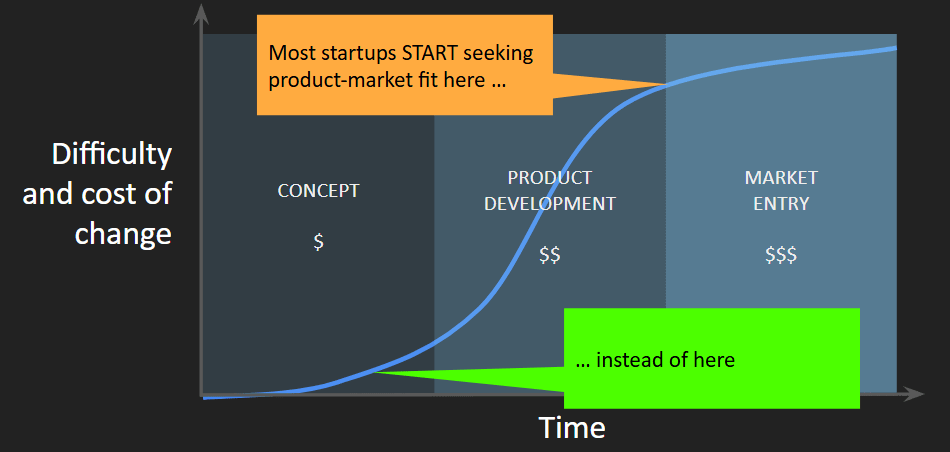
Picture a curve. Time runs along the bottom. The cost of changing your mind runs up the side.
At the concept stage, change is nearly free. It’s an idea and a few documents. During product development, change means throwing work away. By market entry, with a live product, users, investors and a story you’ve told everyone, change is brutally expensive.
The curve starts flat and bends sharply upward. And the big mistake is that most startups start looking for product-market fit at the top of that curve, after they’ve built, instead of at the bottom, before they have. Every lesson the market teaches them arrives at the most expensive possible moment. That’s Splitzee. Five pivots, each one paid for at top-of-the-curve prices.
Here’s the thing I’ve come to believe, though, after watching this happen to a lot of founders, including me. The curve isn’t steep because of dollars. Dollars are part of it, sure. Hours, too. But the real cost of building first is psychological.
Once you’ve built something, your thinking about the market is constrained by it. Every design decision you made encoded an assumption about who the customer is and what they want. Now those assumptions are sitting in the product, looking like facts. When the market pushes back, you don’t hear “this is the wrong product for these people.” You hear “these people don’t get it yet,” or “we need better marketing,” or “let’s add a feature.” You start trying to make the market conform to your expectations of it, instead of the other way around.
That’s the barrier that’s hardest to break. Not the sunk cost in the bank account. The sunk cost in your head.
What AI changes, and what it doesn’t
There’s an obvious objection in 2026. AI has collapsed the cost of building. A non-technical founder can get a working product most of the way there over a weekend. If building is nearly free, why not just build the thing and see who shows up?
Because the cost of building was never the problem. Cheap building doesn’t make finding product-market fit any easier. The discipline is exactly the same whether you have an MVP or not. You still have to figure out which feature set fits which segment, and you still have to get strangers to commit.
What cheap building does is get you to the top of the curve faster. You can go from idea to product before you’ve asked a single stranger for a single commitment, and you arrive there with the same psychological anchor, just sooner. If anything, AI has made it harder to resist building as a form of procrastinating the challenge of finding your customers. It feels like progress. It ends up being avoidance.
Why smart founders do it anyway
This isn’t a mistake dumb founders make. Smart, experienced founders make it all the time. A few reasons stack on top of each other.
It’s what they’ve been taught. The standard playbook says idea, build, launch, grow, and puts go-to-market strategy after the product. At this stage you don’t need a go-to-market strategy. You need a market validation strategy.
They’re tempted to confirm their biases. Founders think they are their customer. They confuse their personal preferences with the truth, and they believe, deeply, that if the product works, people will buy it. Mine worked.
They use validation methods that mislead. Friendly conversations, customer interviews, surveys. All of them feel rigorous. All of them test whether people like your idea, not whether they’ll buy it.
Building is fun. It feels like work and it produces something you can show people.
They raise money too early, believing money leads inevitably to fit. Then they discover investors expect real market validation, fast, and the search for fit is now happening at the top of the curve on someone else’s clock.
The ocean and the rowboat
Here’s the mindset I try to give every founder I work with. It starts with a note of caution: a good product is not the same as a product customers will buy. Startups with great products fail all the time.
The market is an ocean. It’s big and beyond your control. It’s always changing. It doesn’t care how smart you are or how you want it to behave. The best you can do is learn how it works. And it always wins.
A startup is a rowboat. A small group of people with limited supplies, trying to get somewhere before they run out of food and water. Which gives me the only definition of a startup I actually use:
Startup (n.): A group of people trying to find product-market fit before running out of time and resources.

That’s the founder’s job description. Not “build a great product.” Not “raise a round.” Find fit before the supplies run out. Everything else either serves that or distracts from it.
What getting it right looks like
In 2014, Ryan Grepper put a cooler on Kickstarter. Not just a cooler: it had a built-in blender, a Bluetooth speaker, a USB charger, LED lights and a cutting board. He had one prototype and a $50,000 goal.
He raised more than $13 million from over 62,000 backers, at the time the most-funded campaign in Kickstarter history. Before a production line, before a team, before a single manufacturing contract, tens of thousands of strangers committed real money to his value proposition. And it wasn’t his first try. An earlier campaign for the cooler had fallen short. He changed the pitch and ran the experiment again.
People who know how the story ended will tell you the company struggled to deliver. Manufacturing went sideways and a lot of backers waited a long time. True. To me that proves the model rather than contradicting it. The Coolest Cooler found product-market fit about as decisively as anyone ever has. What it struggled with was execution. And solving an execution problem is a whole lot easier when you start with $13 million of your customers’ money instead of a prototype and a hope.
Compare that to Splitzee. Same basic question: will strangers pay for this? Grepper answered it before he built anything. We answered it four years and a million dollars later.
Sell first
The whole argument fits in a few lines.
:: Startups fail because they don’t find product-market fit, not because they build bad products.
:: Fit is a match between a specific feature set and a specific segment, and you have to go looking for it.
:: Look at the bottom of the curve, before you build, while your thinking is still free to follow what the market tells you. Not at the top, after you’ve built, when you’re busy trying to make the market agree with you.
Sell first. Then build. Then plan.
The market is an ocean, and it always wins. You can’t control it. But you can learn how it behaves, cheaply and early, before you’ve loaded the whole company into the boat.
Part 2, Sell First, is coming next: the method I recommend to find product-market fit before building anything.